
On November 3, voters shifted control of Congress, setting up divided government for the final two years of the current administration. Some of our clients are pleased with the outcome. Others are uneasy. Almost all of them are asking the same question: should I be doing something with my portfolio?
Our answer, after every election, is the same. Probably not. Here is what roughly a hundred years of market history says, and why we build plans that do not depend on who wins.
Stocks have risen under both parties
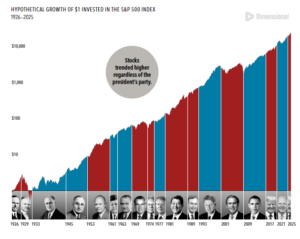
Since 1926, Republicans have held the White House for about 47 years and Democrats for about 51. Over that stretch, U.S. stocks have grown through Republican administrations, Democratic administrations, unified government, and divided government. Since World War II, average annual stock returns have been positive in every presidential term regardless of party.
If your plan requires the “right” party to be in charge, it is a plan that only works about half the time.
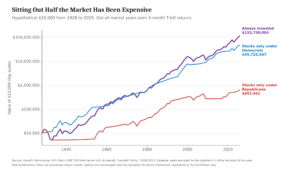
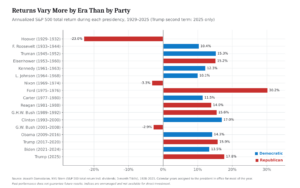
Yes, the averages differ. Here is why that does not matter much.
We would rather be straight with you than tidy. Most long-term studies show higher average returns under Democratic presidents. Data from Dimensional Fund Advisors covering 1926 through 2023 puts the average annual S&P 500 return at roughly 13.7% under Democratic presidents and 9.4% under Republican presidents. A Federal Reserve Bank of San Francisco study found a similar gap for 1926 to 1997, while concluding that returns under the two parties were broadly similar after World War II.
That gap looks meaningful until you look at what drives it:
- Timing luck. Herbert Hoover took office months before the 1929 crash. The 2008 financial crisis landed at the end of a Republican term, and the recovery that followed began under a Democratic one. A few unlucky or lucky starting points move the averages a lot.
- Tiny sample size. Since 1926 there have been only 17 presidents. That is not enough data to separate a real effect from coincidence, and some researchers argue that a couple of extreme episodes account for much of the difference.
- Presidents share the wheel. Congress writes laws. The Federal Reserve sets interest rates. Corporate earnings, inflation, technology, and global events do far more to move stock prices than any one administration.
- Expectations are already priced in. Markets react to how events compare with what investors expected, not to whether a policy sounds business-friendly. That is one reason lower taxes and lighter regulation have not reliably translated into higher returns.
The honest conclusion is not that politics has no effect on markets. It is that party control is a poor predictor of returns, and acting on it has historically cost investors more than ignoring it.
What has happened after midterm elections
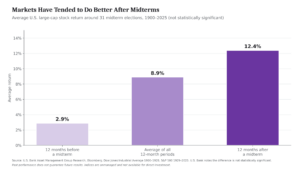
Midterms have a notable track record. According to a Motley Fool analysis of data back to 1874, the S&P 500 has been higher 12 months after 32 of the last 38 midterm elections, with an average 12-month gain of about 14%, compared with about 11% for any 12-month period.
A few details stand out:
- The pattern has held regardless of which party won. After midterms that produced divided government under a Republican president, the market was positive in the following 12 months about 93% of the time across 14 instances.
- Landslides have not been worse for markets than narrow results. Midterms where the president’s party lost 40 or more House seats produced returns similar to those with smaller losses.
- The month right after Election Day has historically been the quiet part, with an average gain of about 0.5% and positive returns only a little more than half the time.
One important caution: researchers at U.S. Bank found the post-midterm pattern is not statistically significant, and outside events explained most of the weak years. History is useful context. It is not a forecast, and past performance does not guarantee future results.
What actually drives long-term returns
Over time, stock prices follow corporate earnings, interest rates, inflation, and productivity. Policy can matter at the margin, and specific sectors such as healthcare, energy, and defense can move on legislative headlines. For a globally diversified portfolio held over decades, those headlines tend to wash out.
That is why our investment approach is evidence-based and globally diversified, and why we do not try to time markets around elections or anything else. Moving to cash because of a political outcome means making two correct calls: when to get out and when to get back in. Few investors get both right.
Where elections do matter: your plan, not your allocation
Elections rarely change what you should own. They can change the rules you plan around. A new Congress shapes the outlook for tax law, estate planning rules, retirement legislation, and healthcare policy, and that is worth paying attention to.
For the families, executives, and business owners we work with, the more useful post-election questions sound like this:
- Business owners considering a sale, including dental and medical practice owners weighing a DSO or private equity offer: how does the current tax and legislative outlook affect deal timing and structure? Talk it through with your CPA and attorney before signing a letter of intent.
- Executives with concentrated stock: are your diversification and 10b5-1 plans built around your goals, or around a guess about Washington? [Link: L&R concentrated wealth post]
- Families with estate plans: when were your documents and beneficiary designations last reviewed against current law? [Link: L&R estate plan drift or beneficiary designations post]
We coordinate this work alongside your CPA and estate attorney, and we do not provide tax or legal advice ourselves. Our role is to make sure the plan fits the rules as they stand and to stress-test it against how they might change.
The bottom line
Your vote is yours, and it matters. Your portfolio should not have a party. The investors who have done best over the last century are the ones who stayed invested through administrations they liked and ones they did not.
If the election has you rethinking your plan, that is a good reason to talk with your Lindberg & Ripple advisor. Not because the market needs a reaction, but because your plan deserves a regular check against your goals.
File# 6102832